
Pekanbaru Death Railway: My Journey Through Time and Shadows
Kategori: History / Sejarah, Diposting pada: 2026/06/10 - 18.10.37
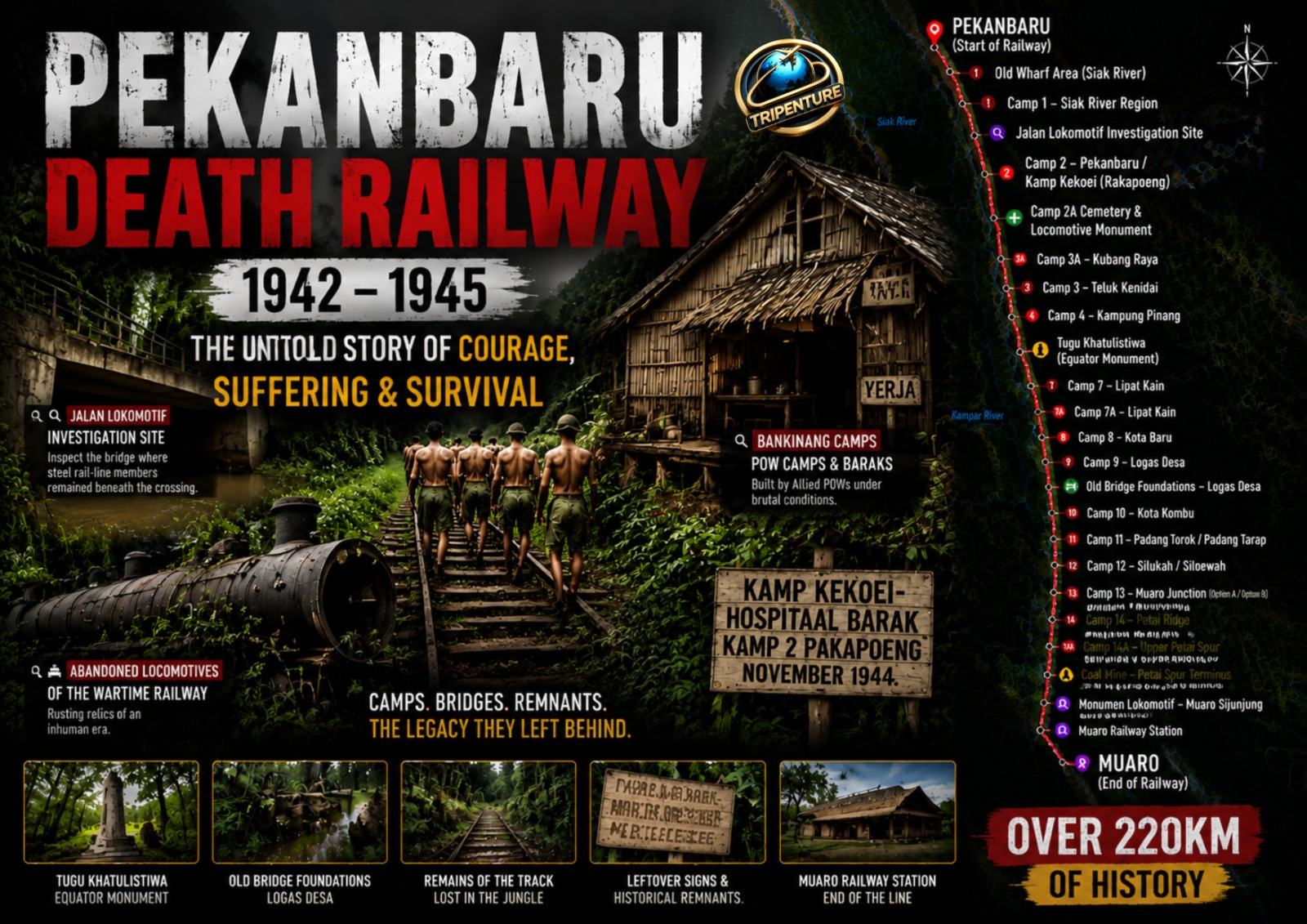
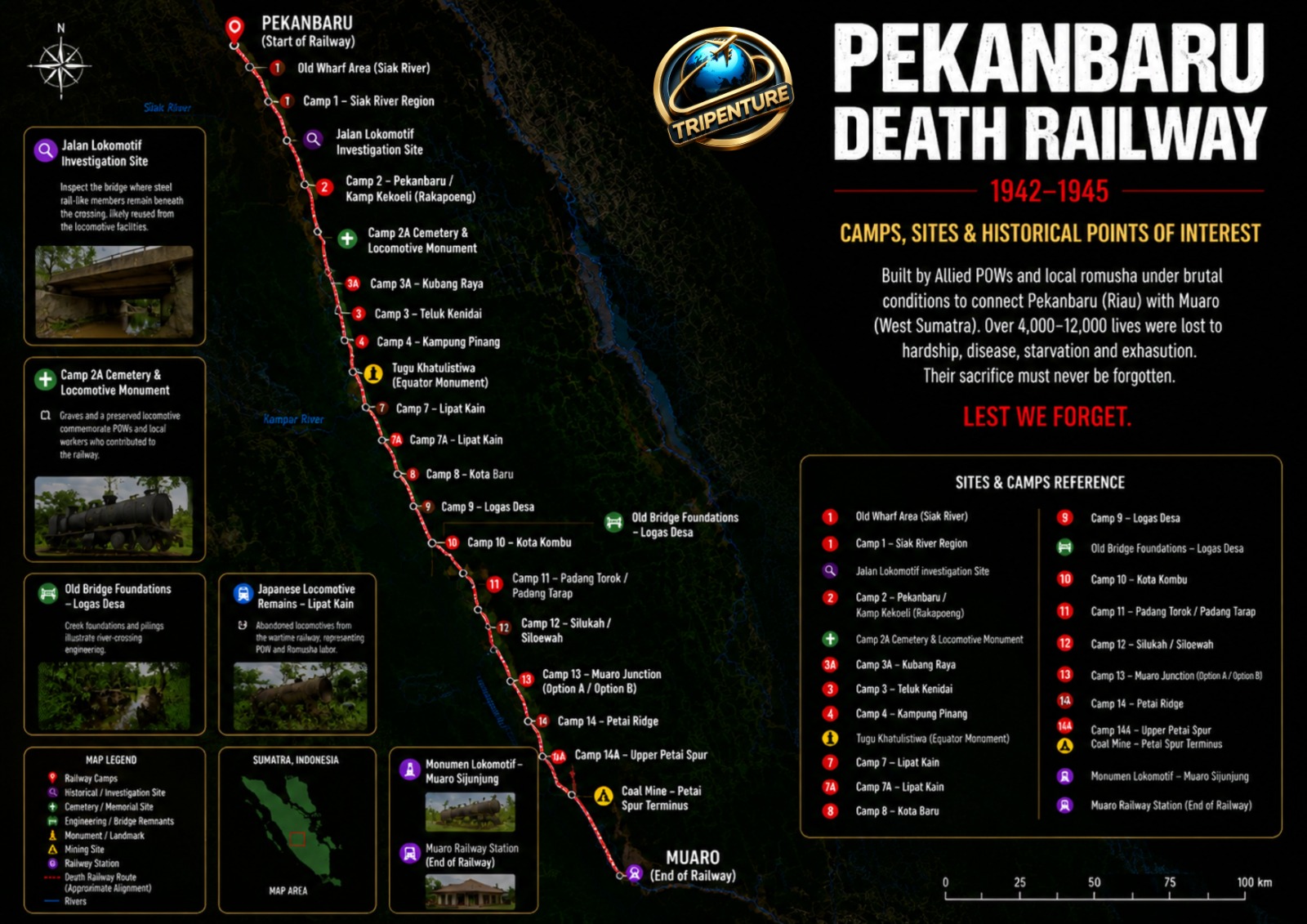 Pekanbaru Death Railway: My Journey Through Time and Shadows
The Pekanbaru Death Railway slices through the jungles, rivers, and hills of Riau, Sumatra, a railway carved with blood, sweat, and sorrow during World War II. Built under harsh Japanese supervision by Allied POWs and tens of thousands of Romusha laborers, it remains one of the most tragic engineering feats of the era.
On May 7th, 2026, Sara messaged me via TourHQ. She asked if I had ever guided a tour of the railway. I admitted I hadn’t. Born in Pekanbaru, I knew bits and pieces, but it was Sara’s interest that sparked this intense journey. Determined to craft a memorable experience, I dove into a rapid investigation of historical sites, mapping camps, old railway lines, and relics. In a very limited fund and time I had, I focused my research on the Pekanbaru area only before Sara and Mark arrived, which is why some locations remained unexplored.
Before Sara and Mark arrived, I managed to chart these early points, gather local stories, and uncover remnants that history textbooks overlook. Yet time was cruelly short. When they finally joined me, we had less than 12 hours to traverse what was meant to be a multi-day exploration.
The journey begins where it all started, at the Siak River old wharf. Once a hub of activity, materials, supplies, and laborers converged here before venturing into the jungle. Now, only whispers of history remain, but standing there, it is impossible not to imagine the chaos and human toil that defined the railway’s construction.
Next, I explored Camp 1, one of the earliest POW and Romusha labor camps. The buildings are gone, but the earth remembers. Every footstep felt like a brush with the past, a silent echo of laborers struggling along the muddy riverbanks.
These two photos show the same location: Camp 2, also known as the Hospital Barrack, Pakapoeng, November 1944. The left image is an AI-enhanced reconstruction based on a POW drawing from the wartime, showing the camp as it may have looked. The right photo captures the present-day site, now transformed into a casual café, where Me, Sara and Mark enjoy coffee while reflecting on the history of the place.
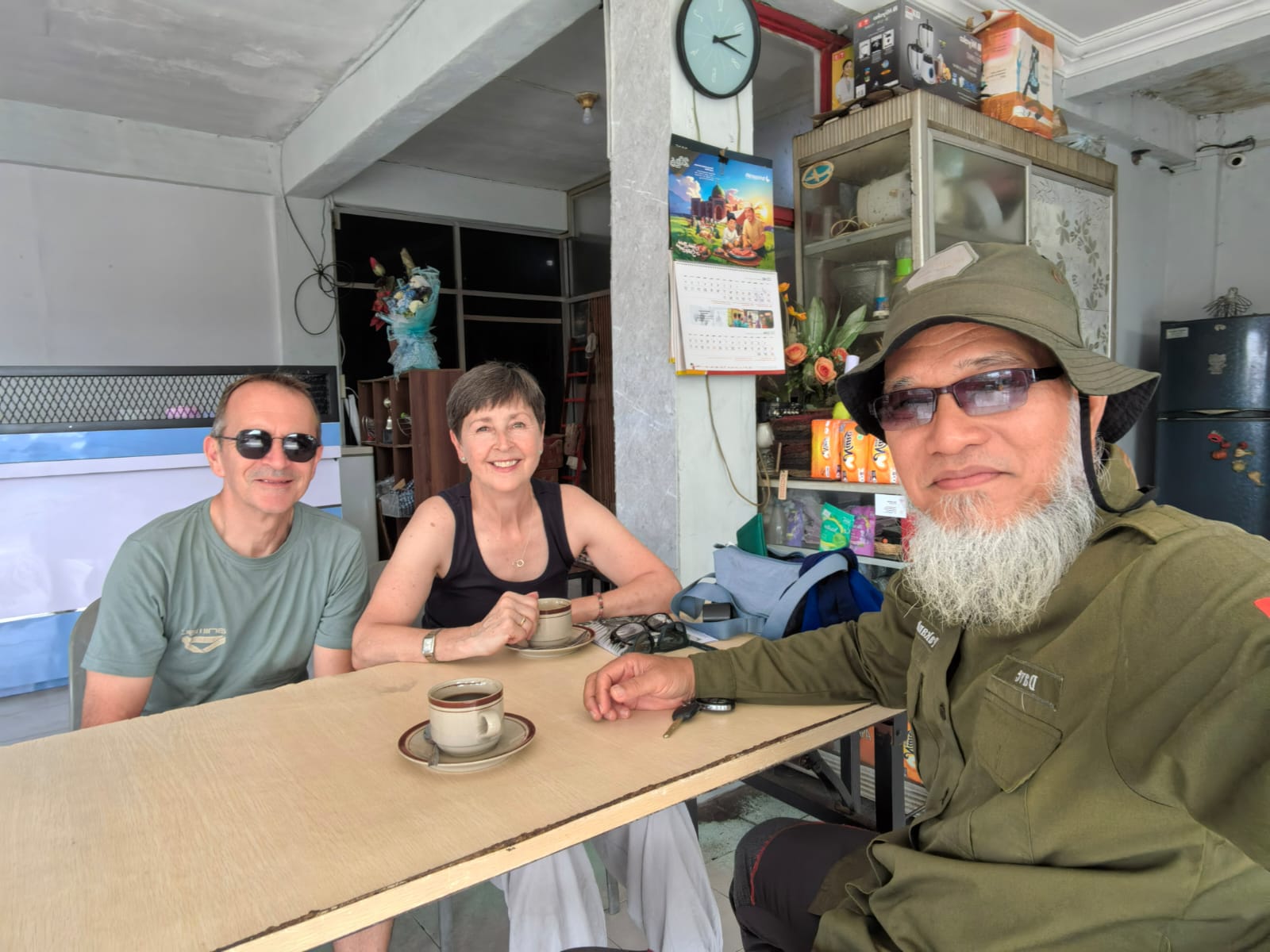
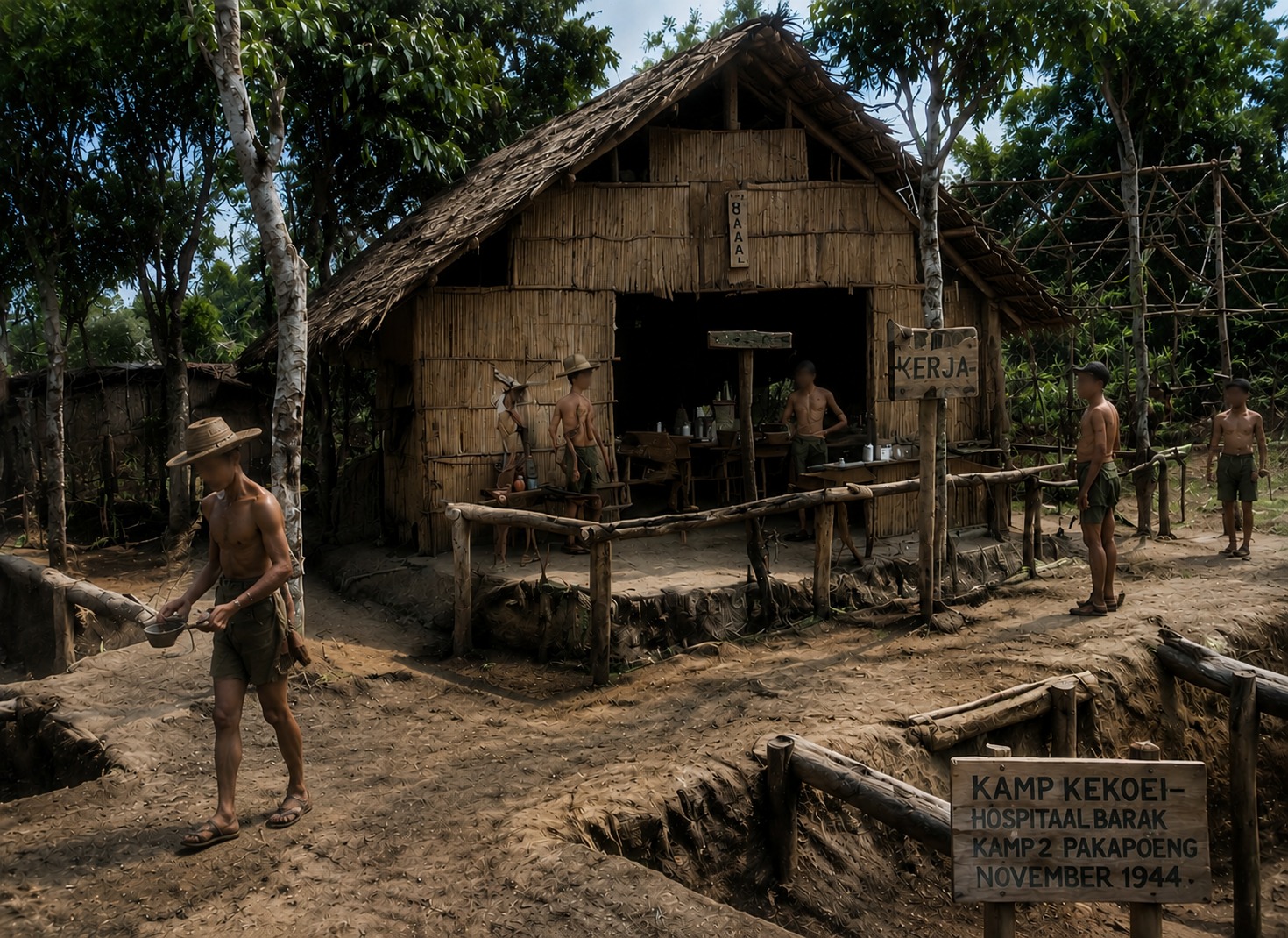 Camp 2, at Jalan Kereta Api Pekanbaru / Kamp Kekoei (Rakapoeng), is where history collides with the present. Originally a POW and Romusha labor camp, it also served as a treatment center where prisoners who fell ill were taken to see doctors, often with rudimentary and unsterilized equipment, and minimal supplies. After the Japanese surrender, Camp 2 became the place where POWs returned along the very railways they had helped lay. From there, they were evacuated to hospitals and eventually made their way home.
Today, the site has transformed in the most surreal way: a carwash, food court, and private residence now sit behind high fences like a fortified compound. Walking past, it feels eerie. Life pulses over the graves of the past, yet the air remains heavy, haunted by memory, a silent witness to both suffering and survival.
I met a local who guided me to Jalan Lokomotif, where steel rails still peek from beneath a bridge. The rusted tracks are ghosts of locomotives that once powered the railway. Standing there, it is hard not to feel the weight of decades of toil and tragedy beneath your feet.
Out of deep respect for Sara’s wishes, we did not visit Camp 3 (Teluk Kenidai) and Camp 3A (Kubang Raya). Sara is the daughter of Walter Cullen, one of the Allied POWs brought to Pekanbaru aboard the hell ships. She wanted to prioritize Camp 4 – Kampung Pinang, where her father had been held, ensuring the visit honored his memory directly. Camp 3 (one skipped location) lie further inland, mostly covered by oil palm plantations and dense forest, and would require dedicated research to explore properly. While we could not walk the ground at these sites, we documented them through maps and archival records to preserve their story. These camps remain crucial pieces of the railway’s history, and I hope to explore them in detail in future research to fully document every site along the railway.
Sara and Mark were enthralled as we navigated Camp 4, where topography still reveals the railway’s historical alignment. Unlike Camp 2, here the wilderness whispers the old stories. Paths and embankments serve as a tangible map of human suffering and engineering under duress.
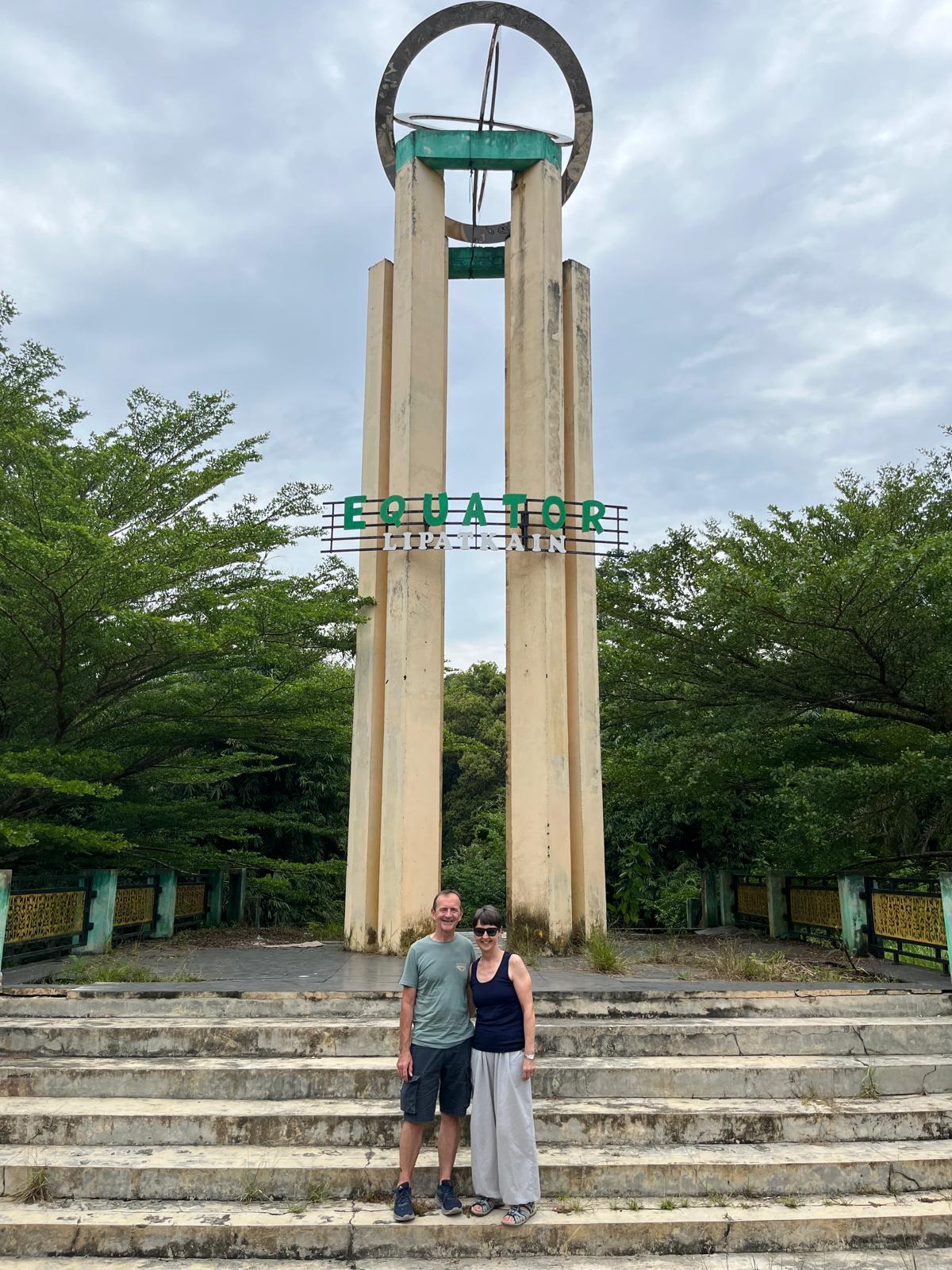 A brief stop at the Equator Monument offered a lighter moment, a rare stretch in an otherwise grueling day. But even here, knowing the railway’s reach brought men to this latitude under impossible conditions cast a long shadow over our photos.
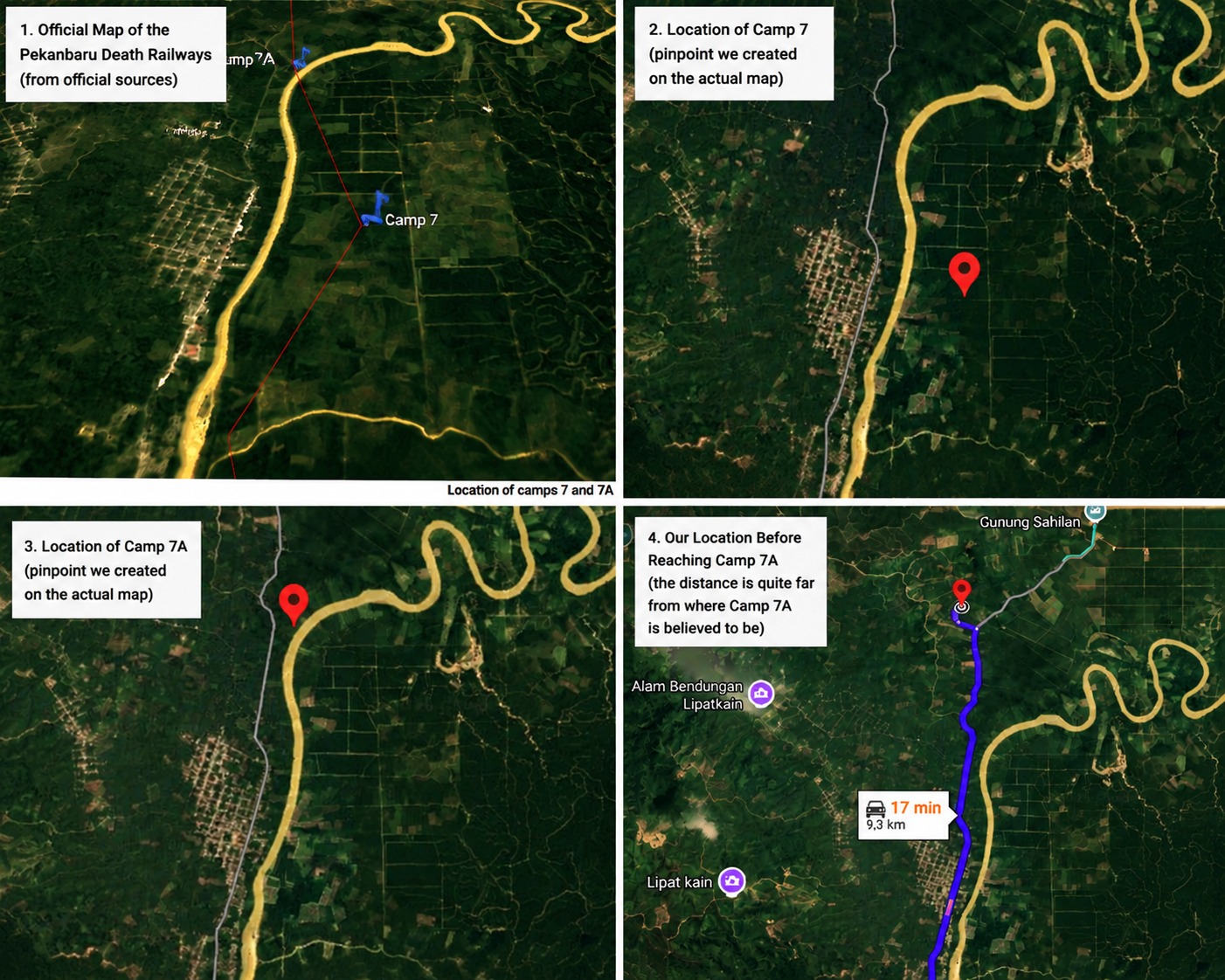
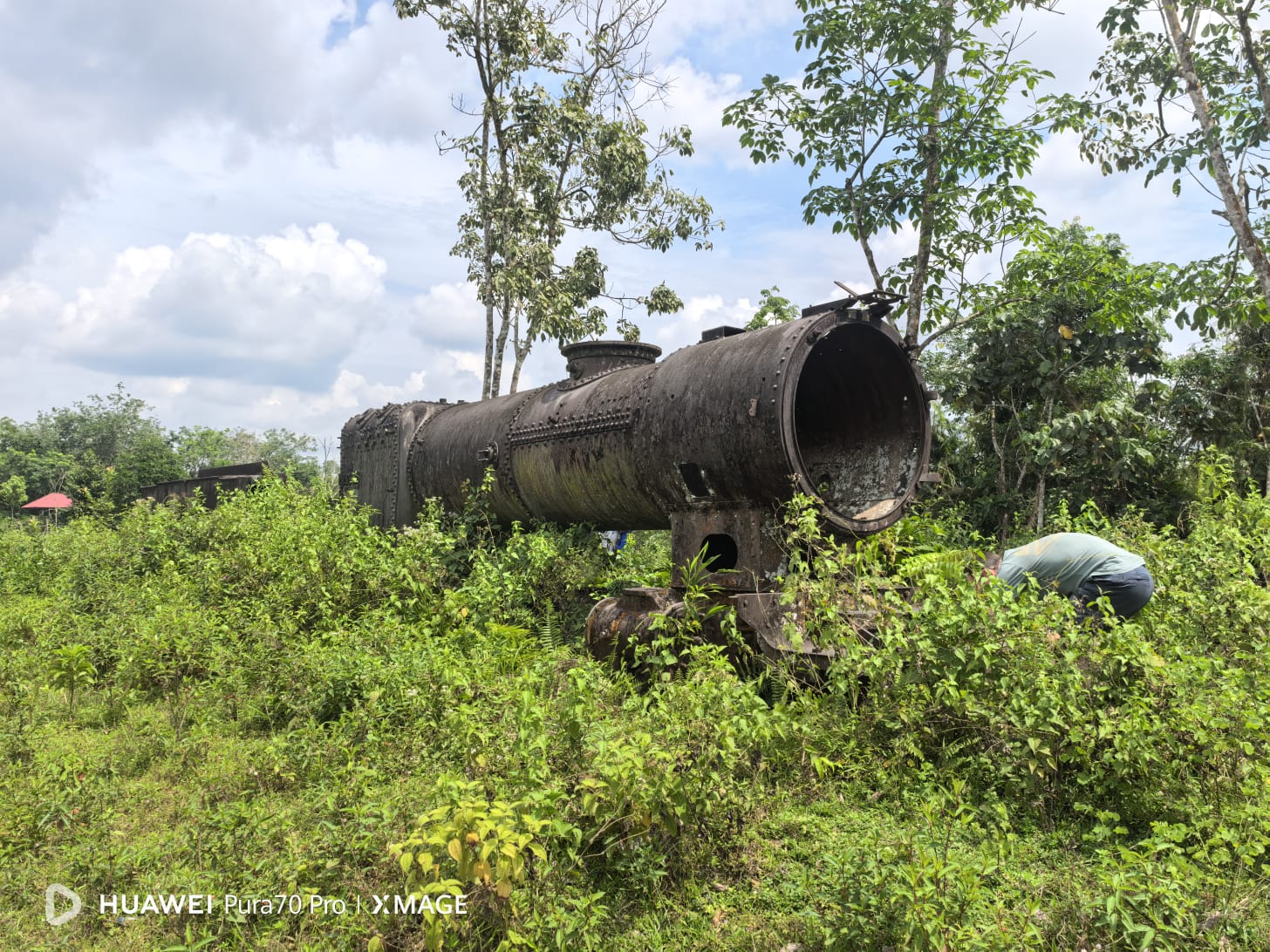 Nearby, we found rusted, abandoned locomotives, silent monuments to the labor that carved the railway through dense jungle. In searching for Camp 7A, we were led into the middle of an oil palm plantation. While at the abandoned locomotive monument, we tried to predict the camp’s location. We arrived thinking we had found it, but after further research, I realized the spot we visited was actually a bit far from the real location. Based on detailed maps and research from websites dedicated to the Pekanbaru Death Railway, I now know the exact locations of Camp 7 and 7A, though they have never been physically visited. We believe after seeing this that the scale of effort and suffering in these remote hills was immense.
 Even in a whirlwind less than 12 hours, many sites remain to be explored in depth. These include Camp 8 – Kota Baru and Camp 9 – Logas Desa, remnants of rails, embankments, and POW cemeteries; Camps 10 to 12 – Kota Kombu, Padang Torok, Silukah, threading through river valleys and gorges; Camp 13 – Muaro Junction, the railway’s terminus where it met the Dutch line, with the Muaro Railway Station and Monumen Lokomotif; Camps 14 and 14A – Petai Ridge and Coal Mine Spurs, extremely challenging terrain requiring extraordinary labor; Camp Bangkinang, a key staging site for POWs before moving inland; old bridge foundations and Romusha labor sites scattered across rivers and embankments; and the coal mines and other temporary camps marking additional hardships faced by laborers along the railway.
I hope to continue this research, visiting each site, documenting their conditions today, and comparing what remains versus what has been lost, to complete a full historical record.
This journey through the Pekanbaru Death Railway is more than a historical tour. It is a challenge to witness what modern life has layered over tragedy. Walking through Camp 2’s bustling “family business” while imagining prisoners’ despair, or tracing steel remnants of locomotives and mapping the true locations of Camps 7 and 7A, made the experience intense, heavy, and unforgettable.
Time, cost, and logistics prevented us from seeing everything, but even in less than 12 hours, Sara and Mark felt the pulse of history. And I, as a Pekanbaru native, found a deeper connection to my city’s hidden scars, a personal and haunting journey through memory, endurance, and the traces of humanity at its limits.
This journey has only just begun, and the Pekanbaru Death Railway still holds many stories waiting to be fully explored. Time, expenses, and resources naturally limit what can be documented in a single visit, but I remain committed to continuing this research, visiting the remaining camps and historical sites, and recording their conditions today. Each step brings us closer to preserving a complete and accurate record, honoring the memory of the POWs and Romusha laborers who endured so much. I hope that, over time, this work will help keep their stories alive for future generations.
Guide in Pekanbaru - Dave - Call/Whatsapp +628127649678 - Instagram @yc5yc - Facebook Davidcy Dave